Faceless business ideas: niches you can fully automate with AI
- faceless business ideas
- faceless niches
- faceless account ideas
- niches to automate with ai
- faceless content ideas
- faceless digital marketing
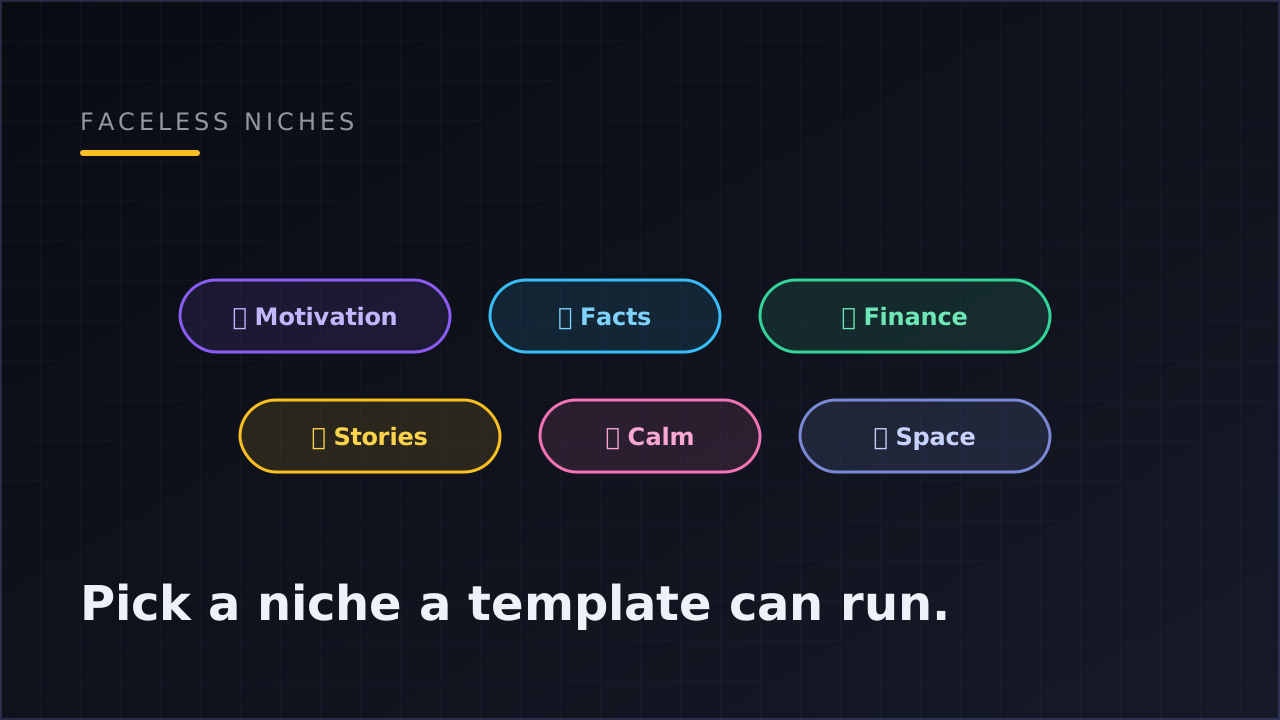
The best faceless business ideas are niches where a repeatable format — not a personality — carries the value: motivation, facts, finance explainers, story narration, calm/ambient content, product teasers and their relatives. Those formats map directly onto AI automation, because what a template can reproduce daily, an automation can run indefinitely.
That mapping is the filter this post applies. Plenty of lists rank "profitable faceless niches"; almost none ask the operational question — can this niche run itself? A niche that needs breaking-news judgment or hand-edited footage isn't a faceless business, it's a faceless job. Here's how to pick one that actually automates, and what the template looks like for each.
The automatability test
Before the list, the filter. A niche fully automates when it passes four checks:
- Episode #100 is describable today. If content depends on this week's news or trends you must chase by hand, the pipeline needs you weekly — forever. Evergreen topics (facts, stories, principles) generate indefinitely from a script prompt.
- A recipe carries the quality. Fixed format, voice, visual style and pacing, with only the topic varying. That's precisely what a template encodes and what a content automation workflow executes per episode.
- Visuals resolve without a shoot. Stock footage, AI-generated imagery with motion, or ambient loops must plausibly carry the format. Anything needing original filmed footage fails the test by definition.
- You can judge the output. The automation produces; someone must occasionally evaluate. Pick a niche where you can tell a good episode from a mediocre one — your taste is the quality control AI doesn't supply.
Notice what's not in the test: passion. You don't need to love finance facts to run a finance-facts account; you need to recognize a good one. Judgment travels further than enthusiasm in automated content.
Nine faceless niches that map to templates
Each entry names the format that does the work and the template configuration that produces it — script style, visuals, voice — because "niche" without "template" is just a topic.
| Niche | What carries it | Template style |
|---|---|---|
| Motivation | Bold lines + delivery | Punchy script, energetic voice, dramatic stock footage or bold AI imagery |
| Facts / "did you know" | Curiosity payoffs | One-fact-per-scene script, crisp voice, image change per scene |
| Finance explainers | Useful clarity | Plain-language script prompt, steady voice, clean graphics-style visuals |
| Story narration | Narrative pull | Long-arc script with cliffhanger pacing, warm voice, single strong visual loop |
| Scary stories | Atmosphere | Slow-burn script, low voice, dark ambient loops |
| Calm / meditation | Mood consistency | Minimal script, soft voice, ambient loops (cheapest visuals in the game) |
| Space & science | Wonder | Explainer script, documentary voice, AI imagery with slow motion pans |
| Luxury / lifestyle | Aspiration aesthetics | Short aspirational script, smooth voice, high-gloss stock footage |
| Product teasers | Desire in 15 seconds | Benefit-led micro-script, confident voice, product-centric imagery |
Three observations across the table:
Visual cost varies more than anything else. Meditation and story niches run on loops — near-zero marginal visual cost. Facts and space niches want fresh imagery per scene — the most expensive visual path. Same automation, several-fold different unit economics; run your niche through the math in what AI faceless content actually costs before committing to a daily cadence.
Script prompts are the moat. Two operators with the same niche and stack differ mostly in the quality of their template's script prompt — the tone, structure and pacing rules every episode inherits. That's where to spend your setup effort.
Every niche here is multi-platform by default. The same vertical video publishes natively to TikTok, YouTube Shorts and Instagram; text-and-image variants of the same brand can extend to X. Distribution divides costs — the niche choice doesn't change that arithmetic.
From niche to running business: the sequence
A faceless business is a loop, not a launch. The build order:
- Pick one niche with the test above — automatable, judgeable by you, visuals within budget.
- Build one strict template. Encode the recipe: script structure with the hook first, voice, visual style, caption treatment. Strict beats loose — drift is what makes automated channels look automated.
- Connect accounts natively (official OAuth, scoped tokens) and wire template → scheduler → accounts.
- Run daily in review mode for a couple of weeks. Approve drafts, tune the script prompt on what you see.
- Let analytics pick your winners. Views, likes, comments and shares attributed per template tell you which format earns its cadence. Scale that; kill or revise the rest.
- Only then add a second niche or account. The operators who fail usually parallelize before anything works; the loop compounds one niche at a time.
The deeper operational reality of running one of these — the weekly rhythm, monetization patience, ownership — is covered platform-by-platform in faceless YouTube channels with AI, and the strategic frame for step five is the create → publish → measure loop.
Picking between finalists: three tiebreakers
If several niches pass the test, break the tie operationally:
Judge-ability beats market size. The niche where you can instantly tell a strong episode from filler will improve every week, because your review-mode approvals and template revisions are informed. The hot niche you can't evaluate will plateau at "generic."
Visual economics at your intended cadence. A loop-based niche at daily cadence can cost less than an imagery-heavy niche at half the frequency. Decide with the per-video estimate in front of you, not after the first invoice.
Format durability. Story and facts formats have survived every platform algorithm shift of the short-form era; trend-surfing formats die with their trend. Boring durability is what you want under an automation that runs for months.
And a candid note on saturation, since every faceless-niche list triggers the question: yes, these niches have competition. Competition filters out inconsistency — which is exactly the variable automation removes. The accounts that quit at week three weren't beaten by saturation; they were beaten by the production treadmill. A pipeline that publishes daily without you changes which side of that filter you're on.
FAQ
What is a faceless business?
A content-driven account or brand where no one appears on camera — the value is carried by a repeatable format: AI voiceover, stock or AI-generated visuals, captions and consistent pacing. Because the format is a recipe, production can be automated end to end, from script to native publishing to analytics.
Which faceless niche is most profitable?
The honest answer: the one you can run consistently and judge critically, in a niche with commercial intent (finance, product-adjacent, self-improvement lean that way). Published RPM rankings change constantly and vary by audience — treat any specific dollar figure you read as unverified. Consistency at a sane cost per video beats niche-picking cleverness.
Can a faceless account really run fully automated?
The production line can: script, voiceover, visuals, captions, render, native multi-platform publishing and metrics collection all run without you. Keep two human touchpoints — draft approval while a template earns trust, and a weekly template-performance decision. That's a couple of hours a week, not a job.
Do I need to show my face eventually to grow?
No. Subscribers in these niches follow the format, not a person — that's the premise. What you do need is format consistency, which is an argument for stricter templates, not for a face.
How many faceless accounts can one person run?
Start with one until its loop demonstrably works — winning template identified, cadence sustainable, unit cost known. After that, each additional account is mostly configuration plus one more weekly review. Operators fail by parallelizing before the first loop closes, not by scaling too slowly after.