Anatomy of a video automation: template → scheduler → publish
- video automation
- automation template
- content scheduler
- native publishing
- automation pipeline
- product
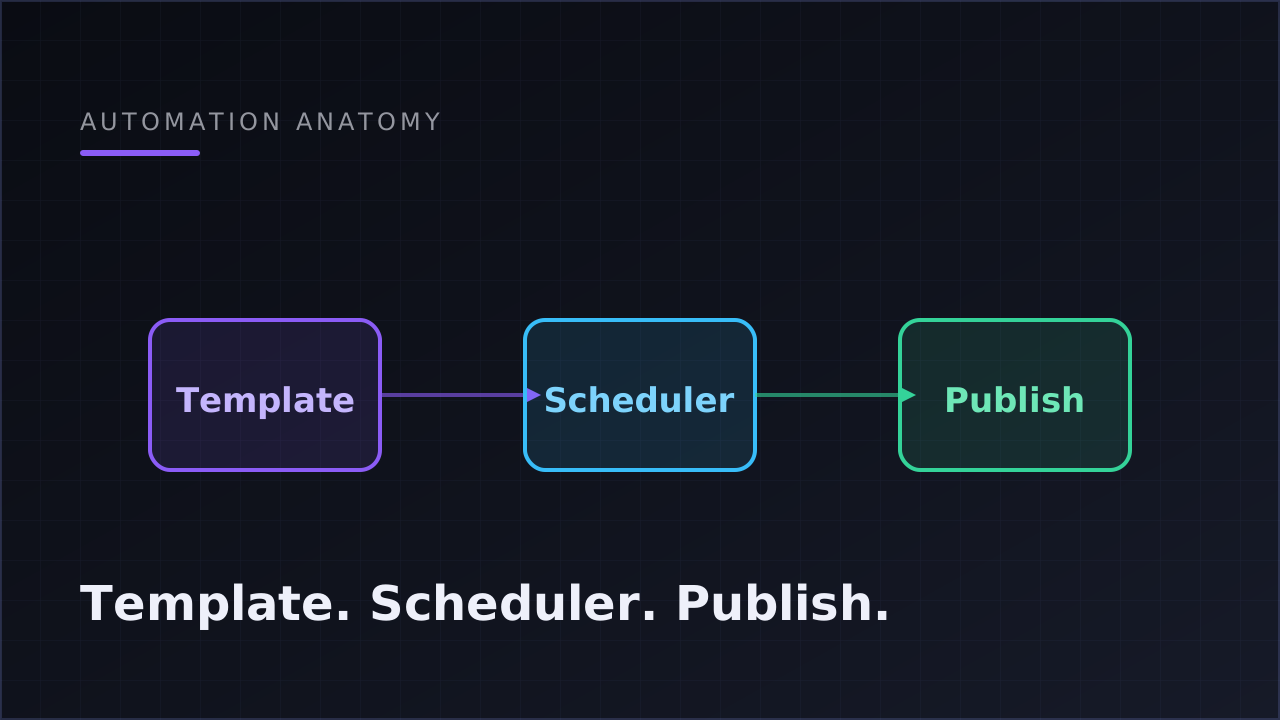
Every video automation, whatever tool builds it, reduces to three blocks wired in a line: a template that defines what a video is, a scheduler that decides when one exists, and a publisher that puts it where people watch. Understanding what each block owns — and what happens at the seams — is most of what separates a pipeline you trust from one you babysit.
Block one: the template
The template is the contract for a single video. It fixes everything that should not change between episodes — aspect ratio, intro pattern, caption style, voice, music bed, outro — and declares slots for everything that should: the script, the footage query, the hook line.
A good template is strict. Loose templates produce videos that drift off-brand by episode twenty; strict templates produce a channel that looks deliberate. The test: hand the template two wildly different scripts and check that both outputs are recognizably the same show.
Templates also carry the render logic. Text-to-speech, caption timing, footage selection and transitions all resolve at render time from the template's rules, which means fixing a pacing problem once fixes it for every future episode.
Block two: the scheduler
The scheduler owns when. It sounds trivial — "daily at 09:00" — but it is where most of the reliability engineering lives, because time is where the real world leaks in.
A scheduler worth trusting handles:
- Time zones, pinned to the channel's audience rather than the server. A 09:00 slot should survive daylight-saving transitions without posting at 08:00 for half the year.
- Lead time. Rendering takes minutes; the scheduler must start generation early enough that the clip is ready at the slot, not started at it.
- Backpressure. If a render fails or runs long, the next slot should not stack a second job on top of a stuck one. Skip, retry or queue — but pick one policy and surface it.
- Pausing. Pausing an automation must be instant and total. Nothing erodes trust faster than a "paused" pipeline that posts one more video.
The scheduler is also where review mode lives: instead of publishing at the slot, finished clips park as drafts until a human approves them, and approvals ride the next slot.
Block three: the publisher
The publisher owns the platform relationship. Each platform has an official API with its own upload flow, metadata rules, rate limits and rejection reasons — the publisher's job is to make those differences invisible upstream.
That means holding tokens securely, refreshing them before they expire, formatting captions and cover frames per platform, and treating rejection as a first-class outcome. A rejected post should retry with backoff, then surface in the dashboard with the platform's stated reason — not silently vanish, and not block the rest of the queue.
The publisher is also the return path. Views, likes and comments flow back through the same connection, land against the specific video that earned them, and give the loop its feedback signal.
The seams are the product
Any demo can wire these blocks together on a happy path. The difference between a demo and a pipeline is the seams: what happens when the render finishes late, the token expired overnight, the platform is down for an hour, or two automations target the same account. If your tool has crisp answers for those four questions, you can stop watching it — which was the entire point of automating.